
Exploring Jungian Archetypes: An Introduction to the Collective Unconscious
THE COLLECTIVE UNCONSCIOUS
Carl Jung proposed that beneath personal memory lies a deeper layer of the psyche, shared by all of us and inherited rather than learned. He called it the collective unconscious, and he described its contents as archetypes: universal patterns that surface in the myths, dreams, and art of every culture.
You have met them, whether or not you knew their names. The wise old guide. The shadow. The hero setting out. The mask we wear in public, which Jung called the persona. These figures recur across traditions that never touched, which is what convinced Jung they belong to something held in common.
THE ARCHETYPES, BRIEFLY
- The Self. The whole psyche, conscious and unconscious together. Jung's emblem for it was the mandala, the circle that contains everything.
- The Shadow. What we repress, deny, or have not yet faced. Meeting it honestly is the beginning of real self-knowledge.
- The Anima and Animus. The inner counterpart: the feminine within the masculine, the masculine within the feminine.
- The Persona. The face turned toward the world. Necessary, and dangerous only when mistaken for the whole self.
- The Great Mother, the Father, the Wise Old Man, the Hero. The elders, guardians, and questers who populate every mythology, and most dreams.
THE RED BOOK
Jung did not leave the collective unconscious as theory. For sixteen years he recorded his own descent into it, in paintings and illuminated script, in a folio he called The Red Book. Its pages hold visions painted with the care of a medieval manuscript: trees whose branches join everything to everything, mandalas drawn as acts of self-repair. It is a strange and beautiful document, and it treats the inner life as something to be met with craft and seriousness.
That is a conviction this house shares.
SYMBOLS ARE HOW THE UNCONSCIOUS SPEAKS
Jung read symbols the way other people read letters. A mandala was not decoration; it was the psyche describing its own wholeness. Artists have always worked this way. Tarot's tower and high priestess, the serpent devouring its tail, the moon in its phases: these images carry meaning that arrives before explanation, which is why they have survived every century that tried to outgrow them.
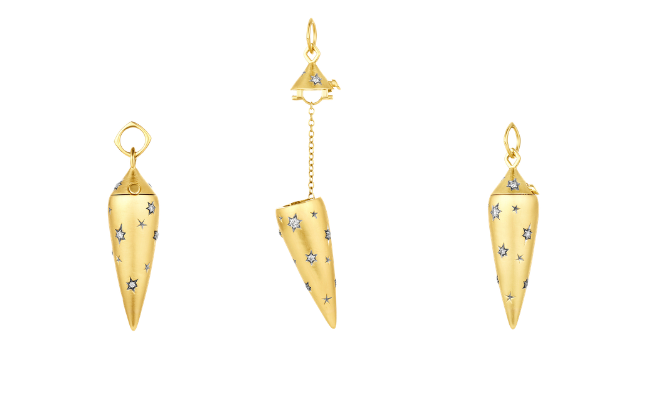
Jewelry belongs to this lineage. A symbol worn on the body is a symbol lived with: touched, warmed, carried through ordinary days until it holds them. The pieces of 12th HOUSE are rooted in exactly this language, the one Jung spent his life transcribing.
12th HOUSE takes its name from astrology's twelfth house, long associated in that symbolic language with the unseen and the interior life. Jung regarded astrology's persistence as evidence of how deeply symbolic thinking runs in us. On that point, at least, the house of the unconscious and the house of jewels agree.