Talisman Jewelry: What a Talisman Is and What Makes One Good
There is a clue hidden in the word. Talisman comes to English through the Arabic tilasm, and behind that stands the Greek telesma: a rite completed, a thing consecrated. Amulet is stranger underneath; Pliny used amuletum two thousand years ago, and no one has ever settled where his word came from. One word carries its meaning openly. The other keeps its origin secret.
But stay with the Greek a moment, because it answers half of the question in this essay's title before we begin. A talisman is not, at root, a thing you find. It is a thing that has been finished: completed by words, by ceremony, by intention. That idea holds steady across three thousand years of making, and it is worth tracing.
A DEMON ON OBSIDIAN
In the Metropolitan Museum of Art there is a piece of obsidian smaller than a playing card, carved almost three thousand years ago in Babylonia. It shows Lamashtu, a demon feared by pregnant women and new mothers, with her lion's head and her clawed hands, surrounded by a comb, a spindle, a pin: the tools of the household she threatened. An incantation in cuneiform wraps around the image and continues across the entire back of the stone, calling on the gods to drive her out.
Notice what the maker did. The danger is named and pictured. The words are not spoken near the stone; they are cut into it, so the stone never stops saying them. More than sixty of these survive, and alongside them the Mesopotamians wore cylinder seals, pierced and strung like beads, which served at once as a legal signature and, it was believed, as protection. Identity and safeguard in a single object worn on the body. Jewelry began doing this work very early.
THE EGYPTIAN SYSTEM
Egypt turned the practice into a system, and the system survives in writing. The Book of the Dead does not simply say to wear an amulet. Spell 155 prescribes a djed pillar of gold, strung on sycamore fibre, placed at the neck on the day of burial, with the words to be spoken over it. Spell 156 prescribes a knot of Isis in red jasper, the color of blood, with its own address: you have your blood, O Isis; you have your power. Material, wording, placement, timing. It is the oldest surviving recipe for making an object good.
And the recipe was followed. When researchers CT-scanned an unopened Ptolemaic mummy in 2023, the so-called Golden Boy, they counted forty-nine amulets of twenty-one kinds arranged in three deliberate columns through the wrappings: a gold tongue amulet in the mouth so the dead could speak, a probable heart scarab at the chest, paired wedjat eyes, and a two-finger amulet set exactly at the embalming incision, where the body had been made vulnerable. An amulet placed at a wound. And the heart scarab tradition carries a plea addressed by the dead to their own heart: do not stand up against me as a witness.
WORDS WORN
The commonest way to empower an object, across three millennia, was to write on it.
The oldest surviving words of the Hebrew Bible are not in a book. They are on two small silver scrolls, excavated in 1979 in a burial chamber outside Jerusalem and dated to around 600 BCE, four centuries before the Dead Sea Scrolls. Unrolled over three years in a museum laboratory, they were found to carry the Priestly Blessing: the LORD bless you and keep you. They were sized to be worn at the neck. Those words survive at all because someone wore them.
The medieval world was dense with this. Scholars call them textual amulets: prayers and charms on parchment, rolled and carried against disease, demons, and misfortune. The British Museum keeps a gold English ring from the late 1400s, the Coventry Ring, engraved with the wounds of Christ and a private charm, its letters once filled with black enamel, its wounds with red. The curators believe the prayer was recited while turning the ring on the finger. Reading as activation; the rite performed on the hand.
And for two centuries English monarchs made rings good with their own hands. Every Good Friday, from Edward III to Mary Tudor, the sovereign blessed gold and silver cramp rings with prayer and holy water, believed to cure seizures and cramp. One condition attached: the rings were held to work only if given without money or petition. What made the ring powerful was not the gold. It was the rite, and the giving.
THE THEORY
The Renaissance finally wrote the theory down. Marsilio Ficino's Three Books on Life, published in 1489, sets out how an object might gather influence from the heavens: through its material, its color, its scent, its image. Behind him stands the Arabic Picatrix, which is stricter still: the right planetary day, the right hour, the object censed with smoke at the moment of completion. Ficino himself stayed carefully ambivalent about the boldest claims, which makes him more credible, not less. His trust settled on the material itself: stone, metal, and scent, rightly chosen and rightly worked.
Read the whole tradition side by side and it agrees with itself. Right material, right words, right moment, right rite, right hands. Across every tradition surveyed here, the answer repeats: a talisman is made good by being finished. The Greek was correct all along.
THE LAGOON AND THE OPEN SEA
Why do humans keep doing this? The anthropologist Bronislaw Malinowski noticed something in the Trobriand Islands a century ago: fishing in the calm lagoon involved no magic at all, while fishing on the open sea, dangerous and uncertain, was wrapped in ritual. Magic lives where chance outruns control. The trenches of the First World War proved him right on an industrial scale; the Imperial War Museums keep the touch-wood charms, the shamrocks worn at the neck, the crooked sixpences, and the Bibles that soldiers said had stopped bullets. Comfort, carried.
The scholar Ellen Dissanayake offers a gentle answer: that humans everywhere take ordinary things and make them special, through formalization, repetition, and elaboration, a behavior rooted in ritual. It is not superstition; it is a way of insisting that some things matter more than others.
WHAT MAKES ONE GOOD
So the title's question answers itself, and the answer is old. A good talisman is made of material that lasts. It carries a symbol that means something real, with a lineage worth tracing. It is finished with intention, by hands that took the time. And then it is worn: against the skin, touched without thinking, through ordinary days and open-sea days alike, until it holds them.
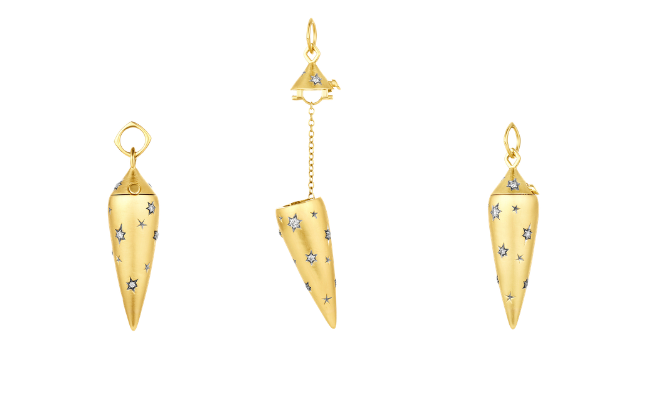
The talismans of 12th HOUSE are made inside this tradition: real symbols, made with care, intention, and attention to detail. The rite completed.